
10 little-known facts about Park Güell
If you are interested in visiting this monument, we are sure you have already read a lot of information: the artistic movement it belongs to, who the author is, its symbolism… However, there are also facts and curiosities about Park Güell that are not obvious at first glance. Today, our mission is to share them with you so that you can keep your eyes wide open during your visit and enjoy it to the fullest.
A unique park with an incredible history
1. It was born from a failure
One of the most striking curiosities of Park Güell is that its creation stemmed from a major commercial failure. Eusebi Güell commissioned Antoni Gaudí to design an exclusive residential development with more than 60 plots and homes surrounded by nature. However, the project was unsuccessful: only two houses were sold.
Difficult access, high prices, and its distance from the city center caused Barcelona’s bourgeoisie to lose interest. Far from disappearing, that failure eventually turned into one of Barcelona’s most iconic spaces.
2. It was sold to the city council
After the death of Eusebi Güell, his heirs decided to sell the land to Barcelona City Council in 1922. As a result, the site became public property and opened as a municipal park in 1926.
Thanks to this decision, today any visitor can freely explore a large part of the site and enjoy a space that would otherwise have remained reserved for the Güell family.
3. Its mosaics are made from leftovers
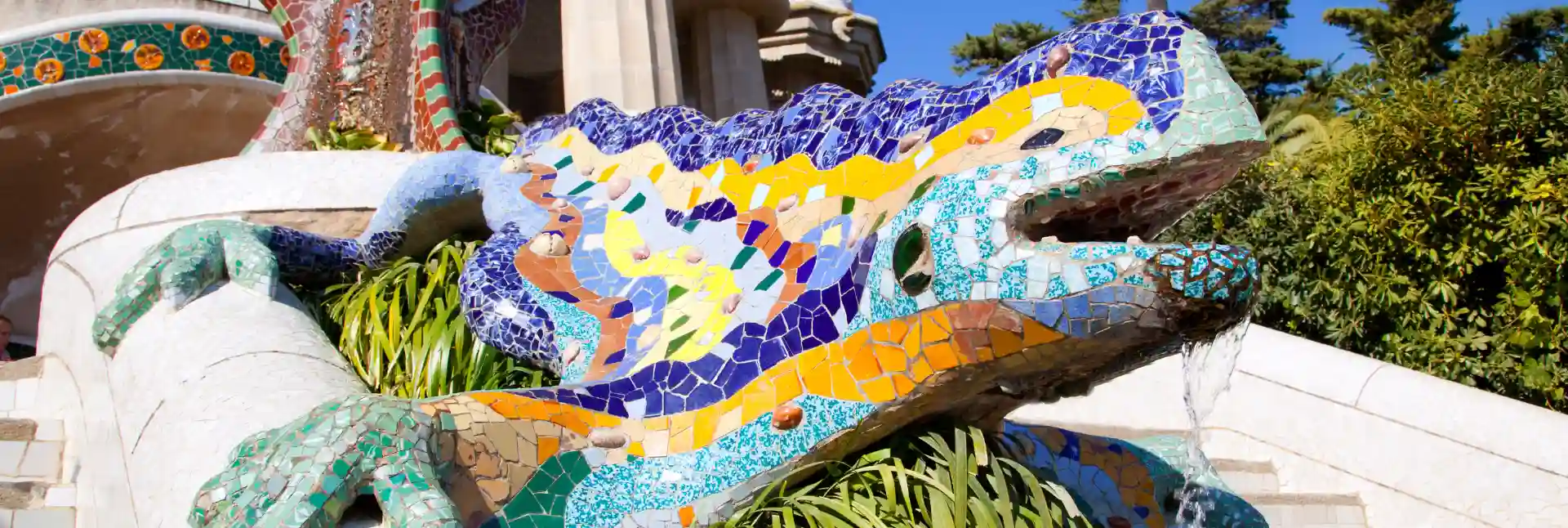
The famous trencadís covering benches, fountains, and sculptures is another of the park’s main highlights. A little-known fact is that these mosaics are made from discarded ceramic pieces: broken tiles, plates, cups, and reused glass fragments.
Gaudí embraced recycling long before it became common practice, giving new life to discarded materials and turning them into true works of art. This detail reinforces the innovative and sustainable dimension of his architecture.
4. Pleistocene remains were found
Among the lesser-known curiosities of Park Güell is its archaeological value. During excavation works, fossil remains dating back to the Pleistocene were discovered, a prehistoric period spanning from over two million years ago to around 10,000 BC.
The remains of elephants, rhinoceroses, and deer are displayed at the Museum of Natural Sciences of Barcelona.
5. Why are they called the Austrian Gardens?
Within the park there is a less frequented area known as the Austrian Gardens. This name comes from the donation of trees from Austria during an exhibition held in Barcelona in the 1970s.
The vegetation in this area differs from the rest of the park and offers a quieter atmosphere, ideal for those who wish to step away temporarily from the most crowded areas.
6. Inspiration from Hansel and Gretel
The two houses located at the park’s entrance, with their wavy shapes and roofs that look as if they were covered in sugar, resemble fairy-tale buildings. Many scholars agree that Gaudí was inspired by the story of Hansel and Gretel.
This reference reinforces the dreamlike character of the park and turns the main entrance into a gateway to a magical world.
7. Masonic references?
Another curiosity of Park Güell that sparks much debate is the possible presence of symbols related to Freemasonry. The main staircase, the number of columns, geometric shapes, and certain mythological references have fueled theories about hidden messages.
Although there is no conclusive evidence, it is true that Gaudí had a deep interest in symbolism and geometry, leaving room for multiple interpretations.
8. Its benches are ergonomic
The famous undulating bench in the main square was designed with human body ergonomics in mind. How? It is known that Gaudí studied anatomy, and it is said that he used plaster molds on real bodies to achieve the perfect curvature. It is also said that he asked workers to sit on it to shape it according to their bodies—how he actually did it remains a mystery.
9. It hides a cistern holding 1,200 cubic meters of water
Beneath the Hypostyle Hall lies a huge cistern capable of storing up to 1,200 cubic meters of rainwater. This system allowed the park to be supplied and its green areas to be irrigated autonomously. Once again, Gaudí was ahead of his time with sustainable solutions integrated into architecture.
10. Did anyone actually live in the houses of Park Güell?
The so-called Model House was built to show what the homes in the development would be like and, in fact, Gaudí bought it and lived there between 1906 and 1925, which is why it is now known as the Gaudí House Museum. The Casa Larrard, on the other hand, was not a newly built house within the project, but a pre-existing home on the estate that Eusebi Güell adapted as a residence and which later, when the site became municipal property, was used as a public school. Finally, the Casa Trias confirms that there were indeed owners and everyday life in Park Güell: it was the home of Martí Trias i Domènech (Güell’s lawyer) and remains a private residence belonging to that family.
Tips before visiting Park Güell
If you are planning to visit Park Güell, we recommend doing so with a specialized guide or an audio guide, as learning about these curiosities on site completely transforms the experience and helps you understand the park as a whole.
If you would like to discover the history, symbolism, and secrets hidden within this monument, we invite you to buy tickets for Park Güell with our guided services and enjoy a complete and engaging experience.